


 Years in Business
 Microsoft Certified Partner
 Client Retention Rate
Choosing a New Legal Software? Here’s Our Guide to Security & Implementation for Chicago Law Firms
Every legal software comparison you’ll find focuses on the same thing: feature checklists. Pricing tiers. User interfaces. But that’s not what actually matters when you’re implementing case management software across your firm. What matters is this: Will it work for your firm’s actual workflow? Can you secure it properly? How much will implementation really cost in time and disruption? And once it’s live, will your team actually use it—or will it sit half-adopted while everyone works around it?
As a leading provider of IT services for law firms in Chicago, CTI Technology has implemented Clio, NetDocuments, and iManage across dozens of law firms. We’ve seen which platforms deliver on their promises and which ones create more problems than they solve. We’ve handled the security configurations that vendors gloss over. We’ve managed the integrations that catch firms off guard. And we’ve watched partners get frustrated when the “easy setup” takes three months and costs twice as much as expected.
This isn’t a marketing comparison. This is what we actually see in law firms. Our team specializes in legal software support, particularly around data security and compliance.
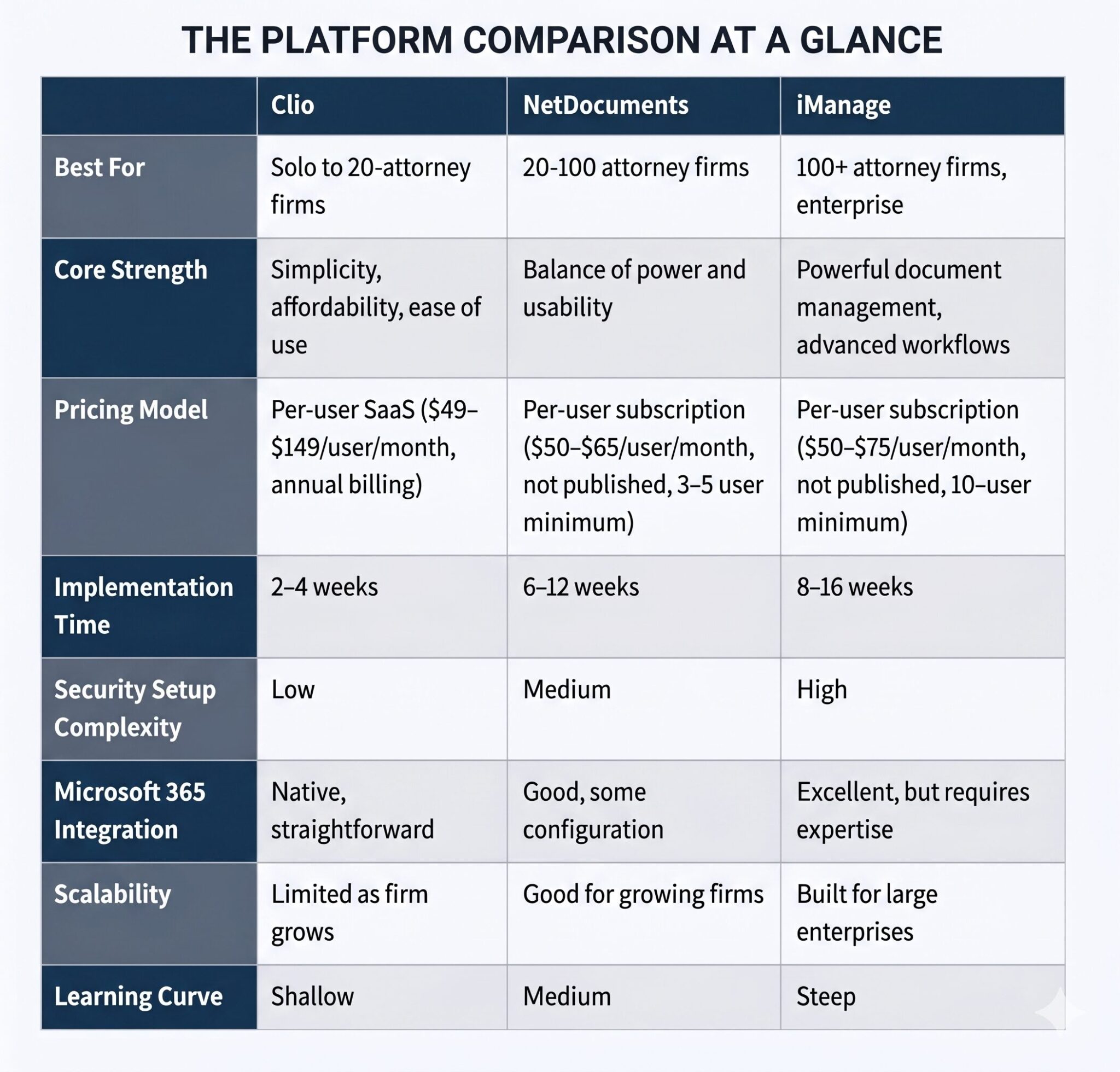
Clio vs. NetDocuments vs. iManage for Chicago Law Firms at a Glance
Below is a quick overview of three popular platforms: Clio, NetDocuments, and iManage…
What Every Legal Software Vendor Skips Over: Security
When you’re evaluating case management platforms, vendors will walk you through features. They’ll show you case workflows, document assembly, time tracking dashboards. What they won’t emphasize is how you actually secure client data in these systems. This matters because your obligation under ABA Rule 1.6 is absolute: client confidentiality is your responsibility. Not the software vendor’s. This is why most law firms benefit immensely from working with an IT company.
See our relevant blog: Do Chicago Law Firms Really NEED an IT Company?
Clio’s Security Reality: Clio handles authentication and encryption well. Data is encrypted in transit and at rest. But here’s what we see in practice: firms often misconfigure user access – leaving administrative privileges too broad. Clio allows you to restrict access at the document level, but many smaller firms don’t implement those controls because the setup feels optional. It’s not. We also see password policies that are too lenient and multi-factor authentication not enforced firm-wide—which means one compromised password puts client data at risk.
The upside: Clio’s cloud-first architecture means patches and security updates happen automatically. You don’t have to manage infrastructure security yourself.
NetDocuments’ Security Reality: NetDocuments gives you more granular control over user permissions and document access. That’s powerful. It’s also more complex to configure correctly. We’ve onboarded firms where NetDocuments was set up with default permissions that were far too permissive—junior associates had access to client matters they shouldn’t have, partners couldn’t be locked out of sensitive documents even when appropriate. These aren’t NetDocuments failures; they’re configuration failures. But the learning curve is steep enough that misconfiguration happens often.
NetDocuments integrates with Microsoft 365 in ways that can enhance security – conditional access policies, threat protection, advanced audit logging – but only if your IT team knows how to set it up. Many firms don’t.
iManage’s Security Reality: iManage was built for enterprise legal environments where security requirements are non-negotiable. The platform offers sophisticated access controls, advanced audit trails, and integration with enterprise security frameworks. If you need to track every access to a sensitive document, iManage can do it.
But that power comes at a cost: complexity. We’ve seen iManage implementations where the security configuration was so detailed that it actually slowed down daily work. Attorneys couldn’t quickly access documents they needed because permission levels were over-engineered. It’s a trade-off between perfect security and practical usability. For most firms, especially smaller ones, iManage’s security capabilities are overkill.
Real-World Implementation: What Actually Happens for Most Chicago Law Firms
Here’s what we see consistently across law firm software implementations:
Clio deployments typically take 2–4 weeks if you’re disciplined. That assumes minimal customization and staff who are willing to change their workflows to match Clio’s design. If your firm has deeply embedded workflows – special naming conventions, unique matter structures, integration with legacy systems – Clio becomes frustrating. It’s built for standardization. Many firms try to force Clio to work like their old system, which defeats the purpose of moving to case management software in the first place.
NetDocuments implementations are longer. Plan for 6–12 weeks if you’re being realistic. The middle weeks are where friction happens: document migration from existing systems (always messier than expected), user acceptance testing (where people discover they don’t like the new workflow), and configuration adjustments (because the first configuration was never quite right). We often see firms underestimate how much time they’ll need to spend on this.
iManage implementations are enterprise-level projects. 8–16 weeks is realistic, and that’s if everything goes smoothly. We’ve seen 6-month implementations for firms that need custom workflows or extensive integrations. Budget accordingly.
Across all three platforms, the hidden costs are consistent: staff time spent on training and transition, interim inefficiency as people learn new systems, and the inevitable go-live surprises (missing integrations, workflows that don’t work as expected, performance issues).
Which Legal Software Platform Is Right for Your Chicago Law Firm?
Choose Clio if: You’re a solo or small firm (under 20 attorneys) that values simplicity and affordability. You don’t have deeply customized workflows. You want a platform you can implement quickly with minimal IT overhead. You’re willing to adopt the platform’s workflow rather than force the platform to fit your existing workflow.
Choose NetDocuments if: You’re a growing firm (20–100 attorneys) that needs more power than Clio offers but doesn’t need enterprise-level complexity. You have some workflow customization needs but not extensive ones. You want excellent document management without overkill. You’re prepared to invest 2–3 months in a thoughtful implementation and ongoing configuration.
Choose iManage if: You’re a larger firm (100+ attorneys) where security, audit trails, and complex document workflows are non-negotiable. You have the IT infrastructure and expertise to configure the platform properly. You’re willing to invest significant time and money in a thorough implementation. You need integration with enterprise systems and workflows.
Implementation Timeline & The Real Cost
When vendors quote implementation timelines, they’re optimistic. Here’s what we actually budget:
Clio: 2–4 weeks
- Reality adjustment: Add 20% for unexpected integrations, training overruns
- Actual timeline: 3–5 weeks
- Cost: Vendor setup fees ($1,500–$3,000) + internal staff time (40–80 hours)
NetDocuments: 6–12 weeks
- Reality adjustment: Add 30–40% for document migration challenges and configuration refinements
- Actual timeline: 8–17 weeks
- Cost: Vendor implementation ($5,000–$15,000) + internal staff time (200–400 hours) + integration costs
iManage: 8–16 weeks
- Reality adjustment: Add 25–50% if you have custom workflows
- Actual timeline: 10–24 weeks
- Cost: Vendor implementation ($15,000–$50,000+) + internal staff time (400–800 hours) + infrastructure costs
The bigger hidden cost: user adoption. If your team doesn’t embrace the new platform, you’ve paid for software and implementation that nobody uses. We’ve seen firms maintain legacy systems parallel to their new case management platform for a year or more because adoption stalled. That’s money wasted.
What We Actually Recommend for Law Firms in Chicago
After implementing these platforms across dozens of law firms, here’s our honest assessment:
For most small to mid-sized law firms, NetDocuments represents the best balance of capability, security, and practical implementation. Clio works beautifully if your firm is truly small and your workflows aren’t complex. iManage is powerful but overcomplicated for most firms outside the Am Law 200.
The real differentiator isn’t the software – it’s your IT foundation. All three platforms assume you have:
- A properly configured Microsoft 365 environment
- Multi-factor authentication enforced firm-wide
- A documented backup and disaster recovery process
- Regular security training for staff
- An IT partner or manager who understands both the legal environment and technology
Get those fundamentals right, and any of these legal software platforms will work. Skip them, and even the best software becomes a security and compliance liability. Our onboarding process starts with a thorough investigation and documentation of your entire environment so we can see what will work – and what won’t. Then we install the right security and monitoring tools, including everything listed above, to make sure your platform works properly.
Ready to Find the Right Platform for Your Chicago Law Firm?
Choosing case management software is a significant decision. But it’s not just a software decision – it’s an IT decision that affects how your firm operates, how secure your client data is, and how efficiently your team works.
If you’re evaluating Clio, NetDocuments, or iManage – or if you’re already using one and wondering if you’re set up securely – let’s talk.
Schedule a 15-minute intro call with our team. We’ll discuss your firm’s specific needs, your current IT foundation, and what platform makes sense for where you are right now.
No sales pitch. No pressure. Just a straightforward conversation about what will actually work for your firm.
Aaron Kane
Why Is CTI Technology The Best Choice For IT Services In The Chicagoland Region?

“Great pricing, even better service. Highly recommended!”
Great pricing, even better service. Highly recommended!”
Guido Arquilla

“Great IT company for our business! Highly recommended.”
“Great IT company for our business! Highly recommended.”
Brian Coli
“CTI is a great company and I would not trust my IT services to anyone else.”
CTI is a great company and I would not trust my IT services to anyone else.
Jenny Wagner