 Years in Business
 Microsoft AI Cloud Partner
 Client Retention Rate
AI in the Real World: 3 Practical Ways Businesses Are Using AI Today
Artificial intelligence is no longer something businesses are only experimenting with.
Across many industries, organizations are using AI to save time, reduce repetitive work, find information faster, and help employees make better decisions.
The most useful AI applications are often not dramatic. They are practical improvements to everyday work.
Here are three ways businesses are already putting AI to use.
1. Turning Meetings Into Useful Summaries and Action Items
Meetings generate a lot of information, but much of it can be lost once everyone moves on to the next task.
AI-powered meeting tools can help by creating:
- meeting summaries
- key discussion points
- decisions that were made
- action items
- follow-up tasks
- lists of questions that still need answers
Instead of asking someone to take detailed notes while also participating in the conversation, AI can provide a starting point for the meeting record.
This can be especially helpful for project meetings, customer calls, internal planning sessions, and recurring team meetings.
The real benefit
The biggest advantage is not simply saving someone 20 minutes of note-taking.
It is making sure important decisions and responsibilities do not disappear after the meeting ends.
Employees can spend more time participating in the discussion and less time trying to document everything manually.
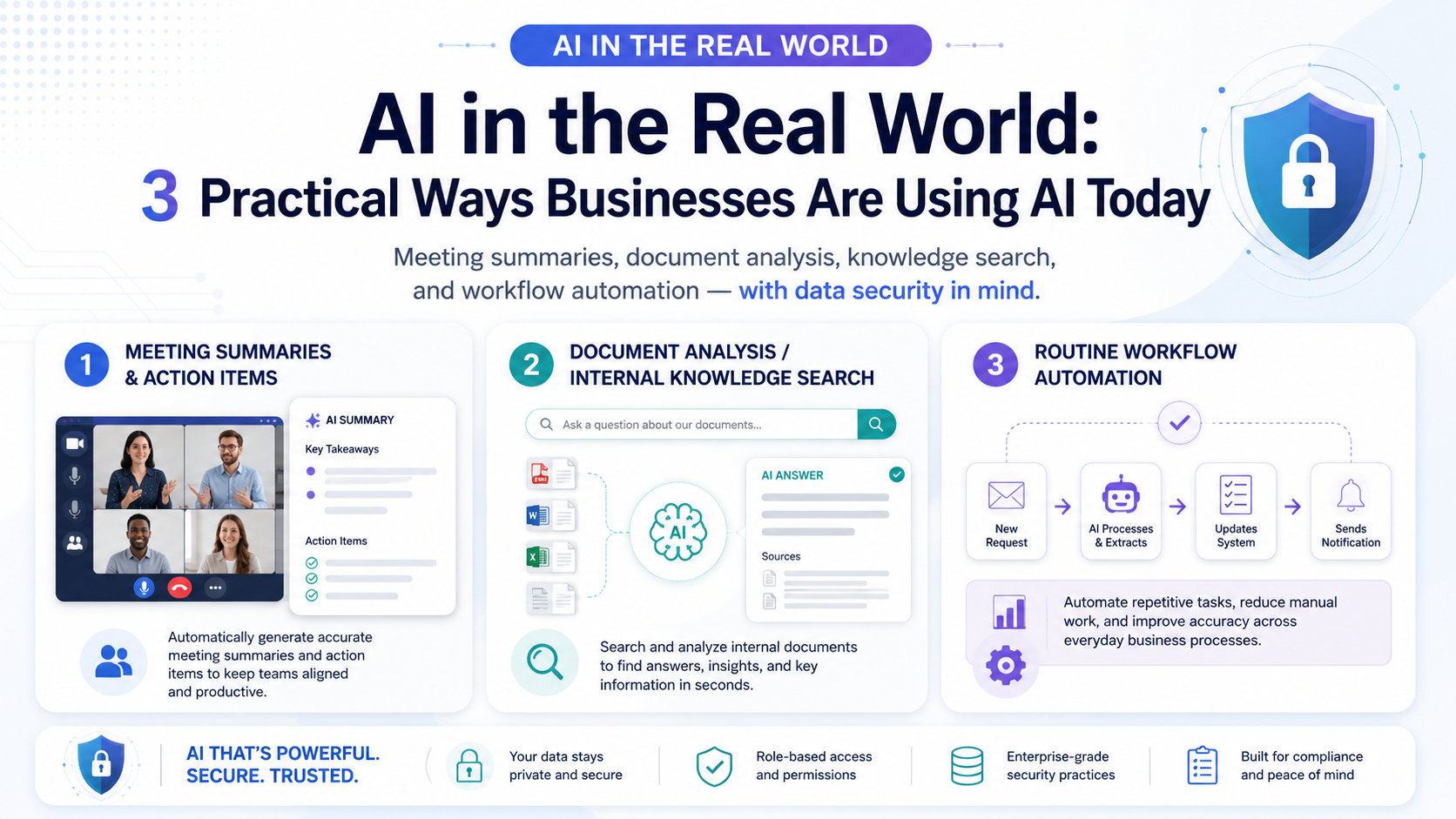
2. Finding Answers Hidden Inside Business Documents
Most organizations already have enormous amounts of useful information.
The problem is finding it.
Policies may be stored in SharePoint. Procedures might live in PDFs. Project information could be spread across Word documents, spreadsheets, emails, and Teams conversations.
AI can help employees search, summarize, and analyze this information much faster.
For example, an employee might ask:
“What is our process for approving a new vendor?”
Instead of manually searching through folders, an AI assistant connected to the appropriate company information may be able to locate the relevant policy and provide a concise answer.
Businesses are also using AI to:
- summarize long documents
- compare contracts or proposals
- extract important information from reports
- identify differences between document versions
- answer questions about internal procedures
- locate information across large collections of files
The real benefit
AI can reduce the amount of time employees spend searching for information they know exists somewhere.
That can be especially valuable for organizations with years of documents and institutional knowledge spread across multiple systems.
3. Automating Routine Workflows
Many employees spend part of every day performing small repetitive tasks.
Individually, those tasks may only take a few minutes. Across an entire organization, however, they can consume hundreds of hours.
AI combined with automation tools can help streamline routine processes.
Examples might include:
- sorting or categorizing incoming requests
- summarizing customer inquiries
- drafting routine responses
- extracting information from forms or documents
- creating follow-up tasks
- routing requests to the correct employee
- preparing recurring reports
- summarizing information before a manager reviews it
The important distinction is that AI does not necessarily need to make the final decision.
In many cases, its best role is preparing the information so an employee can make the decision faster.
The real benefit
The goal is not to replace people.
It is to remove repetitive administrative work so employees can spend more time on activities that require judgment, experience, creativity, and relationships.
Start With the Problem, Not the AI Tool
One of the easiest mistakes businesses can make is starting with:
“We need to use AI.”
A better question is:
“What work is consuming time that technology could help us do more efficiently?”
Look for tasks that are:
- repetitive
- time-consuming
- heavily dependent on searching for information
- based on predictable processes
- creating unnecessary administrative work
Those are often the best places to begin.
A useful AI project should solve a real business problem rather than simply demonstrate what the technology can do.
Do Not Forget About Data Security
AI can provide significant productivity benefits, but businesses also need to think carefully about what information employees are sharing with AI tools.
Sensitive information should not automatically be entered into public or unapproved AI services.
That may include:
- customer information
- financial data
- confidential business documents
- employee information
- passwords or credentials
- contracts
- proprietary intellectual property
Organizations should establish clear guidelines about which AI tools employees are allowed to use and what information may be entered into them.
The same principles that apply to email, cloud storage, and other business technology apply to AI as well:
Know where your data is going, who can access it, and how it is being protected.
AI Does Not Have to Be Complicated
Businesses do not need to transform every process overnight to benefit from artificial intelligence.
A meeting summary that saves 15 minutes, a document search that finds an answer in seconds, or an automated workflow that eliminates repetitive data entry can provide immediate value.
Start small.
Find one task that employees perform repeatedly.
Determine whether AI can make it faster or easier.
Measure the result.
Then build from there.
The organizations that gain the most from AI will not necessarily be the ones adopting the most tools.
They will be the ones using AI deliberately, securely, and in places where it solves real business problems.
Aaron Kane
Why Is CTI Technology The Best Choice For IT Services In The Chicagoland Region?

“Great pricing, even better service. Highly recommended!”
Great pricing, even better service. Highly recommended!”
Guido Arquilla

“Great IT company for our business! Highly recommended.”
“Great IT company for our business! Highly recommended.”
Brian Coli
“CTI is a great company and I would not trust my IT services to anyone else.”
CTI is a great company and I would not trust my IT services to anyone else.
Jenny Wagner
CTI Technology Tips & Articles