 Years in Business
 HIPAA Certified Staff
 Microsoft Certified Partner
 Client Retention Rate
Introduction: Choosing Legal Software in a Higher-Risk Environment
In 2026, legal software decisions carry more weight than ever before. Everything is highly interconnected and needs to flow seamlessly.
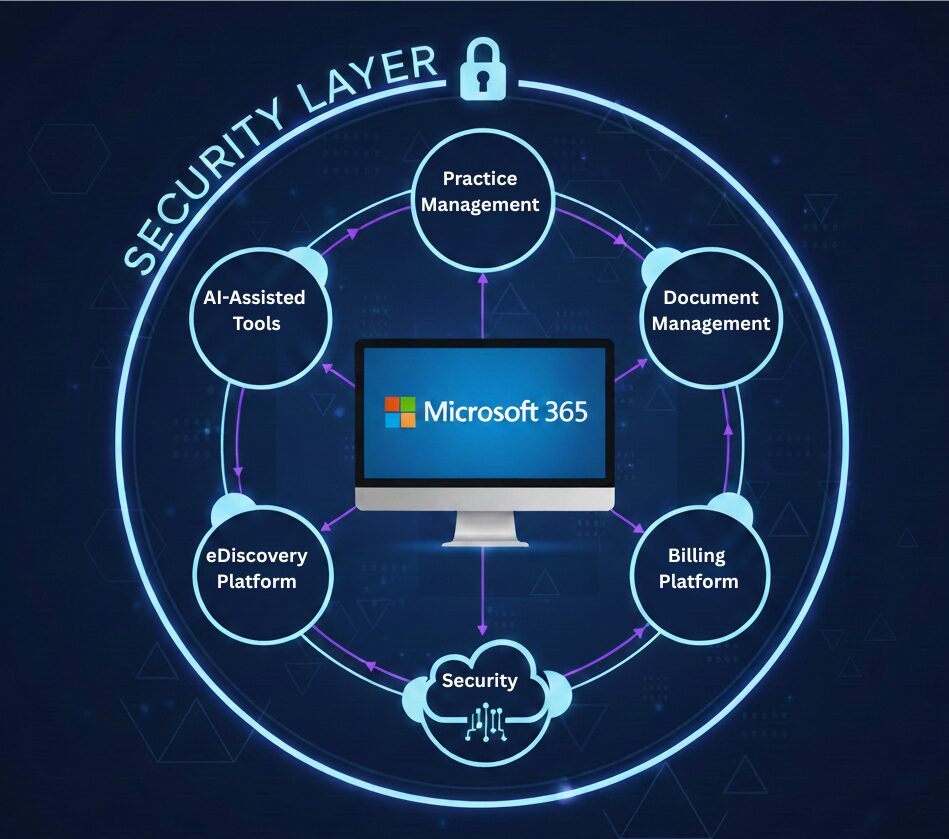
Law firms are no longer simply selecting tools to manage cases or track billable hours. They are investing in systems that directly affect client confidentiality, regulatory compliance, productivity, and firm reputation. The legal industry has shifted toward cloud-first platforms, deeper Microsoft 365 integration, and AI-assisted workflows. At the same time, cyber threats have become more sophisticated, and Illinois data protection requirements continue evolving.
Today’s law firm leaders must evaluate technology not only on functionality, but on security architecture, integration capability, scalability, and long-term risk exposure. CTI Technology has been providing IT services for law firms in Chicago for over 20 years. We’ve put together a guide to help law firms make informed, strategic software decisions that support operational efficiency and professional responsibility.
How Law Firms in Chicago Should Evaluate Legal Software
When assessing any platform, firms should consider:
- Security & compliance alignment
- Integration with Microsoft 365 and existing systems
- Ease of adoption across attorneys and staff
- Long-term scalability
- Total cost of ownership
Software should strengthen workflows, not complicate them. When a law firm is looking for legal software support, the first place we start is reviewing their current setup to make sure it’s secure, properly integrated, and scalable long-term.
Core Legal Software Categories in 2026
Practice Management Systems
The operational backbone of modern firms.
Examples: Clio Manage, ProLaw, Time Matters, PracticePanther
Document Management Systems
Secure, searchable storage structured by client and matter.
Examples: NetDocuments, iManage
Time, Billing & Trust Accounting
Accurate billing and financial controls.
Examples: Tabs3 and related legal accounting platforms
eDiscovery & Litigation Tools
Software that supports document review, indexing, and structured case preparation.
AI-Assisted Legal Tools
Platforms that support drafting, summarization, research assistance, and workflow automation – when securely governed.
Integration & Workflow Optimization
Legal software does not operate in isolation.
Modern firms benefit from structured integration with Microsoft 365, including:
- Matter-based document storage in SharePoint and OneDrive
- Outlook email filing directly into case systems
- Court deadline syncing with Outlook calendars
- Automated Word templates populated by matter data
- Secure collaboration within Teams
Proper integration reduces manual work, improves organization, and strengthens compliance posture.
Security & Compliance in 2026: Non-Negotiable for Law Firms in Chicago
In today’s environment, legal software must be evaluated through a security-first lens. Confidential client data, financial records, discovery materials, and privileged communications all live inside your technology stack. A misconfigured system is not just an inconvenience – it is a liability.
Cyberattacks targeting professional services firms continue to increase. Business email compromise, ransomware, and credential theft are among the most common threats facing law firms. At the same time, regulatory and ethical obligations require attorneys to take “reasonable measures” to protect client information.
CTI Technology not only assists with legal software support, but we specialize in data breach prevention and compliance for law firms. When evaluating any legal software platform, firms should examine:
Encryption & Data Protection
- Is data encrypted at rest and in transit?
- How are encryption keys managed?
- Does the vendor maintain secure cloud infrastructure?
- Is data stored within appropriate geographic regions?
Access Control & Identity Management
- Does the system support role-based permissions?
- Can administrative privileges be limited?
- Is multi-factor authentication (MFA) enforced?
- Does it integrate with Microsoft Entra ID or other identity systems?
Proper access control prevents internal misuse and limits exposure if credentials are compromised.
Audit Logging & Monitoring
- Does the platform maintain logs of user activity?
- Can you see who accessed or modified documents?
- Are logs retained long enough to support investigations?
Audit trails are essential in both breach scenarios and internal disputes.
Retention Policies & Legal Holds
- Can data retention policies be customized?
- Does the system support litigation hold functionality?
- Can records be preserved without accidental deletion?
Retention mismanagement creates significant legal exposure.
Backup & Disaster Recovery
Cloud software does not automatically eliminate risk. Firms should confirm:
- How backups are performed
- How frequently they are tested
- How quickly systems can be restored
- Whether backup data is isolated from ransomware threats
True resilience requires documented recovery procedures.
Vendor Transparency & Security Certifications
While certifications are not everything, firms should evaluate whether vendors maintain SOC 2, ISO 27001, or similar security attestations. Transparency in security posture reflects maturity and accountability.
Security is not a single checkbox. It is an architectural decision that affects every system your firm relies on.
In 2026, law firms that treat security as an afterthought are taking unnecessary risk.
Implementation & Ongoing Support: Where Most Law Firms in Chicago Go Wrong
Selecting legal software is only the beginning. Implementation is where many firms either unlock value or create operational risk.
Firms often underestimate data migration complexity, workflow mapping, permission structuring, and training requirements. A poorly executed rollout can lead to data duplication, inconsistent matter organization, broken integrations, and frustrated attorneys.
Successful implementation requires deliberate planning:
- Workflow mapping before migration
- Structured permission design
- Microsoft 365 integration testing
- Secure remote access configuration
- Early-stage user training
Equally important is post-implementation oversight.
Legal software must be monitored, patched, backed up, and periodically reviewed to remain aligned with evolving compliance standards and firm growth.
Technology should be treated as an evolving operational system, not a one-time purchase.
Looking Ahead: Legal Technology Trends Beyond 2026
- Expanded AI integration across drafting and review workflows
- Greater adoption of Zero Trust security models
- Increased emphasis on vendor security transparency
- Continued shift toward cloud-first legal infrastructure
- Data-driven insights for firm performance optimization
Law firms that plan proactively will avoid rushed technology decisions later.
Supporting Your Legal Software Strategy
Choosing and implementing the right legal software requires alignment between infrastructure, security, compliance, and workflow efficiency. CTI Technology supports Chicago law firms in evaluating, deploying, integrating, and maintaining the platforms they depend on daily – ensuring software enhances performance without increasing risk. As a leading cybersecurity firm in Chicago, we help you maintain client confidentiality at all times – with the right software setup that makes sense for your firm.
Aaron Kane
Why Is CTI Technology The Best Choice For IT Services In The Chicagoland Region?

“Great pricing, even better service. Highly recommended!”
Great pricing, even better service. Highly recommended!”
Guido Arquilla

“Great IT company for our business! Highly recommended.”
“Great IT company for our business! Highly recommended.”
Brian Coli
“CTI is a great company and I would not trust my IT services to anyone else.”
CTI is a great company and I would not trust my IT services to anyone else.
Jenny Wagner
Latest Blog Posts